Sunday, September 8, 2013

figure


“FIGURE-DRAWING INTRODUCTION”

The human form is one of the most compelling subjects an artist can render, and also one of the most difficult.
Figure drawing takes time to master.  The artist must be willing to really study the form, to practice a general approach to the subject without wanting the finished product to be perfect and detailed.  Focusing too early on facial details, clothing details and the surrounding settings are going to interfere with the artist's ability to show a solid form that is in proportion.
The human form is a three-dimensional object with weight and bulk, the figure has depth and thickness.   The artist must first understand and examine the human form before attempting to recreate it.  By exploring the basic construction of the human form, the proportions, the movement ability, the connections, artists will be more able to reproduce accurate human forms in their artwork.
The best way to create a feeling of depth in a sketch is to 'draw through" the solid forms of the body.   This means, sketch some of the contours of the subject whether you can see them or not, like one might in a doodle of a 3-D cube.  Simply drawing a flat outline of the human form is going to give you just that, a flat looking figure with no dimension.
Remove all distracting detail, and begin to construct the basic figure using modified cylinder, sphere, cubic and cone shapes.  If you are able to view the human form in these simple, basic shapes, you will be on your way to creating proportioned, three-dimensional figures.  After you have mastered this, you will have little trouble with the details.
In figure drawing, as in most attempts at realistic or naturalistic rendering, measurement is key.  One must really observe and study the subject in front of him/her, make comparisons between different areas, and note necessary measurements in order to keep the rendering accurate.  Use your pencil to help you line things up properly.  Use lines of measurement called “plumb lines” to make sure everything is in proportion and angled correctly.
The artist uses the human head for the basic unit of measurement for the entire body.  The height of the head from the chin to the top of the head will become the ruler by which the rest of the vertical lines in the form are measured.  Most people are about 7 1/2 head heights tall (including the head), so plan ahead in your drawing by making horizontal and vertical measuring lines on the page before putting in too many details.  The width of the head will be used to measure the horizontal lines in the form as well as the vertical.  The shoulders are usually about three head widths across.
People's body proportions are completely different from one another, but, generally, similar proportions exist.  In children, because they are continuously developing, their proportions may seem rather odd at different ages, evening out as they grow into adulthood.
There are many books available for studying and drawing the human form.  It is a subject that is so in-depth it would be impossible to cover all the techniques and lessons in this short introduction.
Tips to remember when drawing the basic human form:
Visualize the parts of the form in their basic simple forms of cylinder, cube, cone and sphere.
Think of the head as an egg-shaped sphere.
Think of the head measurement from the chin to the top of the head, as a vertical measurement for all other vertical lines.
Think of the head width when making horizontal measurements.
Remember the laws of physics--balance and equilibrium.
Always sketch forms 'through' to the other side even if you can't see them.
Contrapposto--  Italian term meaning "counterpoise" (a force or influence that balances or equally counteracts another) used in the visual arts to describe a human figure standing with most of its weight on one foot so that its shoulders and arms twist off-axis from the hips and legs. This gives the figure a more dynamic, or alternatively relaxed appearance.  Contrapossto is less emphasized than the more sinuous S-Curve.


resources

http://www.pbs.org/art21

http://www.drawingcenter.org/

line

\The Elements: Line

A line is a mark made by a moving point and having psychological impact according to its direction, weight, and the variations in its direction and weight. It is an enormously useful and versatile graphic device that is made to function in both visual and verbal ways. It can act as as a symbolic language, or it can communicate emotion through its character and direction


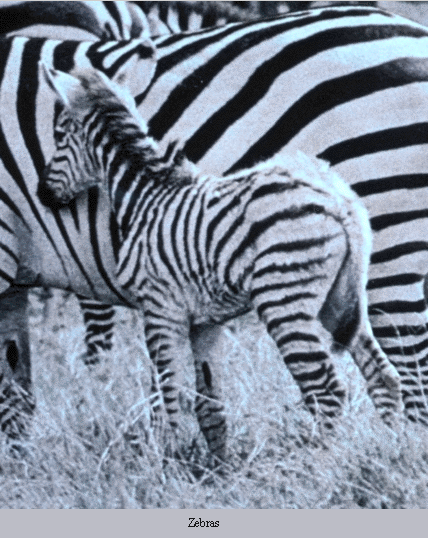
Line is not necessarily an artificial creation of the artist or designer; it exists in nature as a structural feature such as branches, or as surface design, such as striping on a tiger or a seashell.


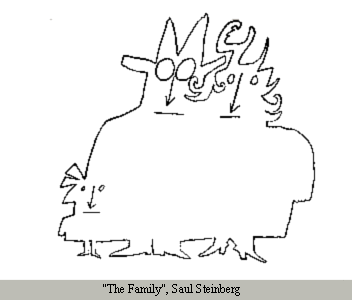
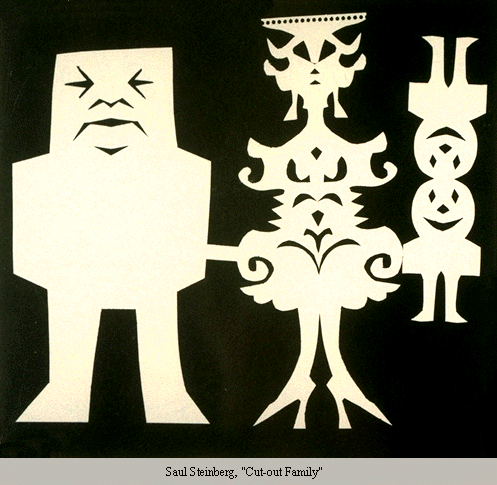
It can function independently to suggest forms that can be recognized, even when the lines are limited in extent. This can be seen in drawings such as the Saul Steinberg illustration shown here, or in Alexander Calder's minimal wire sculptures, which convey a great deal of information about the figure with the most limited line.


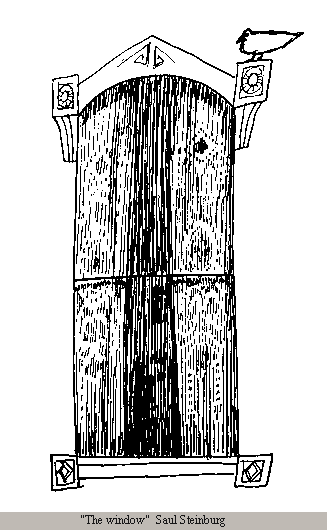
Lines can be combined with other lines to create textures and patterns. This is common in engravings and pen and ink drawings such as the one on the right (click and enlarge to see linear detail). The use of line in combination results in the development of form and value, which are other elements of design.


However, line is not always explicit. It can exist by implication, as the edge of forms. As young children we usually begin drawing landscapes by making outlines for earth, sky, and other objects. Gradually we learn that objects do not have such outlines and we let color changes define the edges of shapes, creating implicit lines. Thus we can speak of a horizon "line," or the "lines" of a car or a fashion silhouette, even though we know there is no literal line present. For additional visual examples of


Expressive Qualities of Line

Certain arrangements of line are commonly understood to carry certain kinds of information.


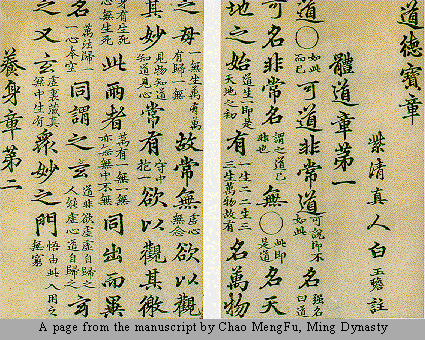
For example, calligraphy is recognizable as a representation of words, even when we do not know the language. Calligraphic imagery is often used by modern artists simply because of the mysterious messages implied in the "code" of unknown language.


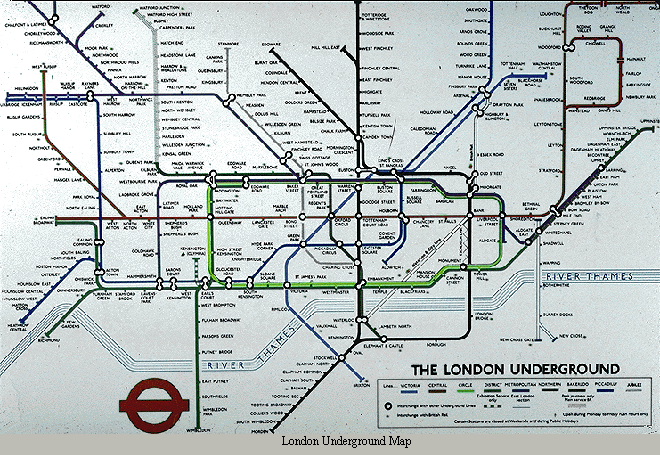
Line in the form of maps is readily recognized as a symbolic representation of a place. The place may be a local neighborhood, or the entire world. It may be a carefully measured representation, or a stylized diagram, such as a subway map. In either case, we understand it to be a device by which we can understand the relationship between places; how to get from "here" to "there."


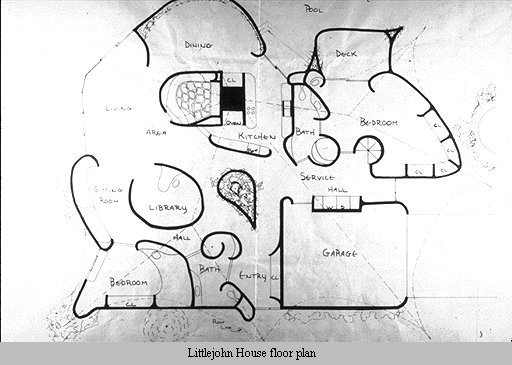
Floor plans are a specialized kind of map, a commonly understood device which describes a building. This linear language can be understood even when the building is as unusual as this one, which was to be constructed of a sprayed foam material in a decidedly unconventional form.


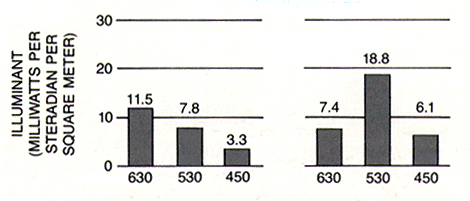
Graphs are another readily recognizable linear device. They are widely used to communicate quantitative information and relationships in a visual way. From the time we first meet them in basic algebra, to the last time we picked up a copy of USA Today, we encounter and interpret graphs.


Line also communicates emotion and states of mind through its character and direction. The variations of meaning generally relate to our bodily experience of line and direction.


Horizontal line suggests a feeling of rest or repose. Objects parallel to the earth are at rest in relation to gravity. Therefore compositions in which horizontal lines dominate tend to be quiet and restful in feeling. One of the hallmarks of Frank Lloyd Wright's architectural style is its use of strong horizontal elements which stress the relationship of the structure to the land.


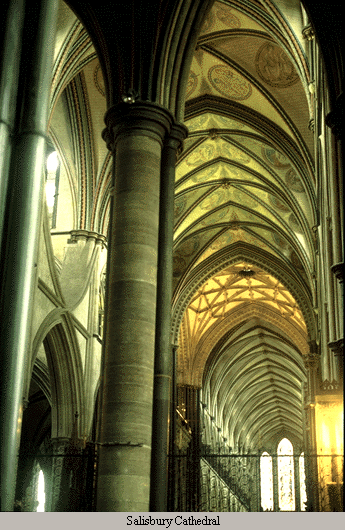
Vertical lines communicate a feeling of loftiness and spirituality. Erect lines seem to extend upwards beyond human reach, toward the sky. They often dominate public architecture, from cathedrals to corporate headquarters. Extended perpendicular lines suggest an overpowering grandeur, beyond ordinary human measure.


Diagonal lines suggest a feeling of movement or direction. Since objects in a diagonal position are unstable in relation to gravity, being neither vertical nor horizontal, they are either about to fall, or are already in motion, as is certainly the case for this group of dancers. In a two dimensional composition diagonal lines are also used to indicate depth, an illusion of perspective that pulls the viewer into the picture-creating an illusion of a space that one could move about within. Thus if a feeling of movement or speed is desired, or a feeling of activity, diagonal lines can be used.


Horizontal and vertical lines in combination communicate stability and solidity. Rectilinear forms stay put in relation to gravity, and are not likely to tip over. This stability suggests permanence, reliability and safety. In the case of the man in this family group, the lines seem to imply stability to the point of stodginess.

Deep, acute curves, on the other hand, suggest confusion, turbulence, even frenzy, as in the violence of waves in a storm, the chaos of a tangled thread, or the turmoil of lines suggested by the forms of a crowd. The complicated curves used to form the mother in the family group shown above suggest a fussy, frivolous personality.


Curved lines do vary in meaning, however. Soft, shallow curves suggest comfort, safety, familiarity, relaxation. They recall the curves of the human body, and therefore have a pleasing, sensual quality.

The quality of the line is in itself a fundamental visual language, to an extent that cannot be claimed for any other single element. Its use is so universal that we are all profoundly sensitive to it. Even without an artist's training, we can extract considerable meaning from the kind of line used in a drawing. It is possible to recognize the soft, irregular lines of a quick sketch from life, as seen in this study of a lion.


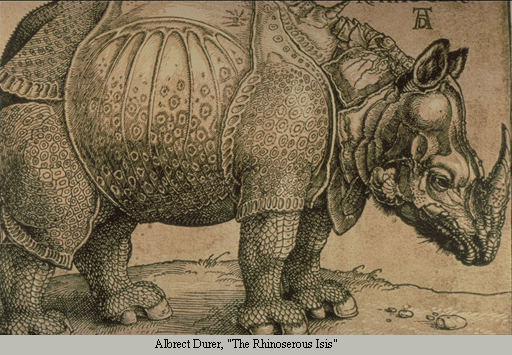
On the other hand, the crisp, carefully placed lines of the rhinocerous are typical of a more studied, scrupulously worked studio drawing. The lines suggest that this was not drawn from life, but from hearsay. This is also evident from the fact that Durer drew this rather inaccurate image in fifteenth century Europe when he could only have known of this African animal from travellers' tales.


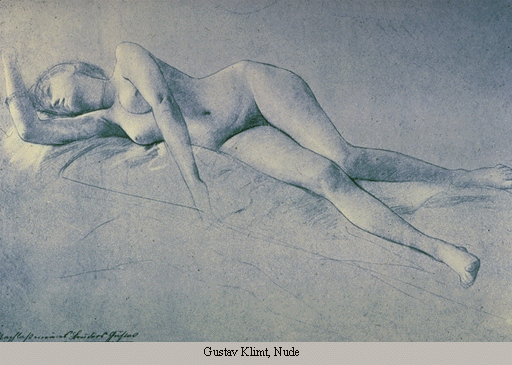
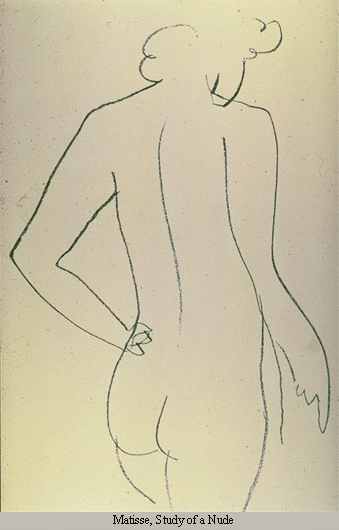
The quality of line in itself contributes to the mood of the work, and for the master artist, the quality of line is a fundamental expression of his/her style. This drawing of a nude by Matisse demonstrates his ability to create his image through a minimal number of expertly placed lines-lines that by their placement and movement on the page identify this work with this artist as surely as a signature.
For additional examples of how line works in design, follow this link.

contour

http://en.wikipedia.org/wiki/Contour_drawing


http://en.wikipedia.org/wiki/Blind_contour_drawing


http://youtu.be/fjJhZ4DYh50

Contour drawing

From Wikipedia, the free encyclopedia
Jump to: navigation, search

A contour drawing by Egon Schiele.
Contour drawing, is an artistic technique used in the field of art in which the artist sketches the contour of a subject by drawing lines that result in a drawing that is essentially an outline; the French word contour meaning, “outline.” [1] The purpose of contour drawing is to emphasize the mass and volume of the subject rather than the detail; the focus is on the outlined shape of the subject and not the minor details. However, because contour can convey a three-dimensional perspective, length and width as well as thickness and depth are important; not all contours exist along the outlines of a subject.[2] This technique is manifested in different styles and practiced in the honor of drawing development.

Contents

Importance

Contour drawing is an essential technique in the field of art because it is a strong foundation for any drawing or painting; it can potentially modify a subjects’ form through variation within the lines. Its objective is to capture the life, action, or expression of the subject.[2] It is widely accepted among schools, art institutions, and colleges as an effective training aid and discipline[3] for beginner artists. In the hands of a talented master, the line that conveys contour can deliver a load of visual pleasure that can be astonishing.

Technique

In a continuous-line drawing, the artist looks both at the subject and the paper, moving the medium over the paper, and creating a silhouette of the object. Like blind contour drawing, contour drawing is an artful experience that relies more on sensation than perception; it’s important to be guided by instinct.[2] To make a blind contour drawing, an artist does not look at the paper or canvas on which he/she is working.[2] Another technique similar to contour drawing is outline drawing; a division between form and the space a subject occupies.[4] All three types of drawing are considered to be gesture drawings;[4] the practice of drawing a series of bodies in still form. An outline drawing does not include the visual amusement of human sight, while a contour drawing contains form, weight, mass, space, and distance.[4]

Styles

By altering the character of the mark, an artist can emulate many aspects of the subject that relate form and space to the viewer. For example, a line can be lighter in value, or gradation, to suggest greater distance between objects in the drawing. A darker portion of the contour could represent an object with little or no light source; the space is compressed or the object is lower.[4] Continuous lines used inside the outline of a subject can an accent or cast shadow, depending on the value of the line.

Practice

The purpose of drawing blindingly is to force the artist’s eye to move along the contour of the subject as his or her pencil moves along the paper. Initially, this type of drawing may be difficult and slow, but an artist will find that with practice, it is an effective way of defining observation skills such as identifying and underlying the structure of the subject, relating forms, and conveying the sensual experience of the subject; he/she will be skilled at drawing anything quickly and successively.[2]

References

  1. ^ http://www.etymonline.com/index.php?term=contour
  2. ^ a b c d e Sutherland, Jane. 1997. "Gesture drawings." American Artist (VNU eMedia, Inc.) 61, no. 656: 11. Academic Search Complete, EBSCOhost . Retrieved February 9, 2010.
  3. ^ Nicolaïdes, Kimon. 1941. "The Natural Way to Draw". Houghton Mifflin Company Boston
  4. ^ a b c d Sheenan, Steven. 1994. "Two types of line drawings." American Artist (VNU eMedia, Inc.) 58, no. 625: 10. Academic Search Complete, EBSCOhost . Retrieved February 9, 2010.

glossary

glossary of terms

-->
Aerial View:
Also called a bird's-eye view. Observing from a point of view at a high elevation.  In perspective, when the horizon line, and thus the vanishing point (-s), have been placed near or above the top of the picture frame. This applies most often to landscapes, cityscapes, etc. (Be careful not to confuse aerial view with aerial perspective.)
Aerial/Atmospheric Perspective:
The means by which the illusion of atmospheric distance and depth is created by rendering objects in background space with less edge and value contrast.  May also be accompanied by a shift from warmer to cooler hues. softer focus or lighter value.
Abstraction:
The reduction or simplification of an image or object to an essential aspect (geometric or organic) of its form or content.
Axis:
An imaginary straight line that indicates movement and the direction of movement.
Background:
Objects or undetermined spaces surrounding the main subject of a work.
The most distant zone of space in three-dimensional illusion
Backlight:
A light source positioned behind a person or object that can create a silhouette or separate the person or object from the background.
Base Tone:
The darkest tone on a form, located on that part of the surface that is turned away from rays of light.

Blind Contour:

Line drawings produced without looking at the paper. Such drawings are done to heighten the feeling for space and form and to improve eye-hand coordination

Cast Shadow:

The shadow thrown by a form onto an adjacent or nearby surface in a direction away from the light source.
Chiaroscuro:
A word borrowed from Italian ("light and shade" or "dark") referring to the modeling of volume by depicting light and shade by contrasting them boldly. This is one means of strengthening an illusion of depth on a two-dimensional surface, and was an important topic among artists of the Renaissance.

Composition:

The organization and interaction of shapes, forms, lines, patterns, light and color.
Cone of Vision:
The visual area represented by the drawing usually corresponding to a normal person’s vision, minus their peripheral vision. (about 60 degrees) Angle of sight.

Content:

The subject and meaning of a work of art.
Continuous Line Drawing:
A drawing in which the implement remains in uninterrupted contact with the picture plane creating enclosed shapes.
Contour:
The outline and other visible edges of a mass, figure or object.

Contour Line (Drawing):

A single line that represents the edge of a form or group of forms and suggests three-dimensional quality indicating the thickness as well as height and width of the form it describes. Contour line drawing uses subtle overlapping planes.
Convergence:
In linear perspective, parallel lines in nature appear to converge (come together) as they recede to a point on the Eye Level or Horizon Line. into the picture plane.

Cross-Contour Lines:

Multiple, curving parallel lines running over the surface of an object horizontally and/or vertically that describe its surface qualities. Much like wire framing in 3D design.
Cross Hatching:
A drawing technique to shade an object using two or more networks of parallel lines in a gradual angular progression (to achieve a build up of complex value).

Diminution:

In linear perspective, the phenomenon of more distant objects appearing smaller.
Drawing:
Depiction of shapes and forms on a surface chiefly by means of lines. Color and shading may be included. A major fine art technique in itself, drawing is the basis of all pictorial representation, and an early step in most art activities. Though an integral part of most painting, drawing is generally differentiated from painting by the dominance of line over mass.
Edge:
The rim or border, the place where two things meet: the background (negative space) meets surface of objects (positive space),  a “tone” or “value” meets a different tone/value.

Eye Level:

In linear perspective, the height at which the eyes are located in relation to the ground plane. Standing creates a high eye-level while sitting creates a lower one. In most views, the eye level will match a horizon line. The same as horizon line. All vanishing points in one and two point perspective are positioned on the eye level.

Figure:

The primary or positive shape in a drawing. A shape that is noticeably separated from the background. The figure is the dominant, advancing shape in a figure/ground relationship.
Figure-Ground Relationship:
An arrangement in which positive and negative shapes alternatively command attention. Also known as a positive/negative relationship.

Foreground:

The “nearest” space represented to the viewer.  The “front” of the visual stage.
An exaggeration of perspective in which elements nearer to the viewer are shown much larger, and elements at a distance appear much reduced in size.
Foreshortening:
A technique for producing the illusion of an object’s extension into space by contracting its form. A way of representing a subject or an object so that it conveys the illusion of depth -- so that it seems to go back into space.
Freehand Drawing:
Drawn by hand, without the use of any mechanical device -- without the aid of a straightedge, compass, protractor, French curves, computer equipment, etc. This is the opposite of mechanical drawing.


Gestalt:

A total mental picture, or conception, of a form.

Gradation:

Any gradual transition from one tone to another. In drawing, shading through gradation can be used to suggest three-dimensional illusion.
Gesture:
A spontaneous representation of the dominant physical and expressive stance of an object. The act of making a sketch with relatively loose arm movements (gestures) -- with the large muscles of the arm, rather than with the small muscles of the hand and wrist; Or a drawing made this way.
Grid:
A framework or pattern of criss-crossed or parallel lines. A lattice. When criss-crossed, lines are usually horizontal and vertical; and when lines are diagonal, they are usually at
right angles to each other.
Ground:
The actual flat surface of a drawing, synonymous with a drawing’s opaque picture plane. In a three dimensional illusion, ground also refers to the area behind an object (or figure).
Half Tone:
After the highlight and quarter tone, the next brightest area of illumination on a form. The halftone is located on that part of the surface that is parallel to the rays of light.
Highlight:
The brightest area of illumination on a form, which appears on that part of the surface most perpendicular to the light source.
Horizon Line:
In linear perspective, the line on which all vanishing points are positioned. More accurately described as the eye line or eye level.
Layout:
The placement of images within a two dimensional format.
Light Tone:
After highlight, the next light value of illumination on a form. Sometimes called indirect light.
Line:
A mark with length and direction. An element of art which refers to the continuous mark made on some surface by a moving point. Types of line include: vertical, horizontal, diagonal, straight or ruled, curved, bent, angular, thin, thick or wide, interrupted (dotted, dashed, broken, etc.), blurred or fuzzy, controlled, freehand, parallel, hatching, meandering, and spiraling. Often it defines a space, and may create an outline or contour, define a silhouette; create patterns, or movement, and the illusion of mass or volume. It may be two-dimensional (as with pencil on paper) three-dimensional (as with wire) or implied (the edge of a shape or form).
Line gesture:
A type of gesture drawing that describes interior forms, utilizing line rather than mass.
Local Value:
The basic tonality of an object’s surface. regardless of incidental lighting effects or surface texture.
Mark:
A visible trace or impression on a surface, such as a line, a dot, spot, stain, scratch, etc.
Mass:
The density or weight of an object.
Massing:
In composition: to block-in forms with the purpose of achieving an overall organization of visual weight
Mass gesture:
A system of broad, gestural marks used to create density and weight in a form.
Middle ground:
The area between the foreground and background in a drawing.
Modeled Drawing:
A method of drawing which delineates form through the use of a variety of values-A range of tones from light to dark.

Motion:

The arrangement of the parts of an image to create a sense of movement by using lines, shapes, forms, and textures that causes the eye to move over the work.
Negative Space:
The space surrounding a positive shape; sometimes referred to as a ground, empty space, field, etc.
Outline:
A line of uniform thickness, tone and speed, which serves as a boundary between a shape or form and its environment. It does not suggest contour, and is therefore flat, two dimensional. A silhouette.
Overlapping Planes:
A method of representing hierarchy of space in a drawing. Overlapping occurs when one object obscures from view part of a second object.
Planar Analysis:
A structural description of a form in which its complex curves are generalized into major planar zones.
Perspective:
Any system used to represent depth or space on a flat surface by reducing the size and placement of elements to suggest that they are further away from the viewer.
One-Point Perspective:
A frontal, head on view with a central point at eye level at which all receding parallels appear to converge and vanish.
Two-Point Perspective:
A way of representing space on the picture plane in which physically parallel elements of the same size appear progressively reduced along converging rays to the left and right, reaching a single point on the horizon on both the left and right side.
Three Point-Perspective:
A system for representing objects in space with exaggerated three dimensionality, through the use of three perpendicular sets of converging parallels.
Picture Frame:
The physical vertical and horizontal dimensions of the paper surface.
Picture Plane:
The flat, two-dimensional surface on which a drawing is made.
Plane:
Any flat level or surface.
Plastic:
Denotes the illusion of three dimensionality or movement into the picture plane as it relates to the flat, two-dimensional nature of the picture plane itself. We refer to this as plastic space in contrast to perspective space.
Positive Space:
The shape of an object that serves as the subject for a drawing. The relationship between positive shape and negative space is sometimes called figure/ground, foreground/background relationship.
Proportion:
A term that refers to the “accurate” relationship of part to part in a realistic drawing. It can also refer to the expressive purposes, e.g. Distortion of proportion to consciously or unconsciously achieve a subjective intention. Proportion also relates to a sense of balance.
Reflective Light:
The relatively weak light that bounces off a nearby surface onto the shadowed side of a form.
Relative Scale:
A way in which to represent and judge the spatial position of an object in three-dimensional illusionistic space so that forms drawn smaller appear further away and forms that are drawn larger appear closer.
Representational:
A drawing that attempts to achieve a near-likeness to the objects being drawn. Drawings which strive to achieve the qualities of realism.
Rendering:
A depiction or an interpretation. Also, a drawing in perspective of a proposed structure. (Rendering can be used either as a noun or as a verb.)
Scale:
A ratio or proportion used in determining the dimensional relationship  between a representation to that which it represents (its actual size), such as maps, building plans, and models.
Shallow Space:
A relatively flat space, having weight and width but limited depth.
Shape:
A contained, edged-in area on the two-dimensional surface. Or an area that suggests containment. A shape is always interdependent with another element (shape or space) in the composition.
Sighting:
The visual measurements of objects and spaces between objects.
Silhouette:
Any dark two-dimensional shape seen against a light background.

Sketch:

A quick drawing that loosely captures the appearance or action of a place or situation. Sketches are often done in preparation for larger, more detailed works of art.
Space:
The distance between images or points in a drawing. We contain space when defining edges of interrelated shapes.
Station Point:
In linear perspective, the fixed position a person occupies in relation to the subject that is being drawn.
Surface:
The actual physical structure or texture of the drawing paper containing degrees of smoothness, gloss, or roughness.
Texture:
The actual or suggestive surface quality of a two-dimensional shape or three-dimensional volume. Texture can be created by using skillful drawing techniques, erasure, rubbing, or employing specific materials such as sand.
Two Dimensional Space:
The flat, actual surface area of a drawing, which is the product of the length times the width of the drawing paper support.
Three Dimensional Space:
The actual space in the environment, and the representation of it in the form of pictorial illusion.
Value:
Black, white and the gradations of gray tones between them. The relative degree of light and dark.
Value Relativity:
The changing visual identity of values in juxtaposition, sometimes called value contrast.
Value Scale:
The gradual range from white through gray to black.
Value Pattern:
The arrangement or organization of values that control compositional movement and create a unifying effect throughout a work of art.
Visual Weight:
The potential of any element or area of a drawing to attract the eye.
Volume:
The overall size of an object, and by extension the quantity of three-dimensional space it occupies.